
The Roman Republic Calendar
All Roads Lead to Rome

Introducing the Roman Republic Calendar
Here I will be trying to metaphorically kill 3 birds with one metaphorical stone, the Roman Republic Calendar. First of all, I need to deal with the issue (the first metaphorical bird) of the timeline of the 16 Days to Triumph. Subsequently, I need to deal with the issue (the second metaphorical bird) of the Modern Jewish Calendar. After that, I will want to deal with the issue (the third metaphorical bird) of the search for a Messianic calendar where the Messiah was born on a significant New Year, restoring authenticity and credibility to the concepts of BC & AD. To sum up, we will be investigating these 3 main issues: (1) the 16 days to triumph; (2) the modern Jewish calendar; and (3) the search for the true New Year.
The Three Main Metaphorical “Roads” that lead to Rome
(1) The Sixteen Days to Triumph
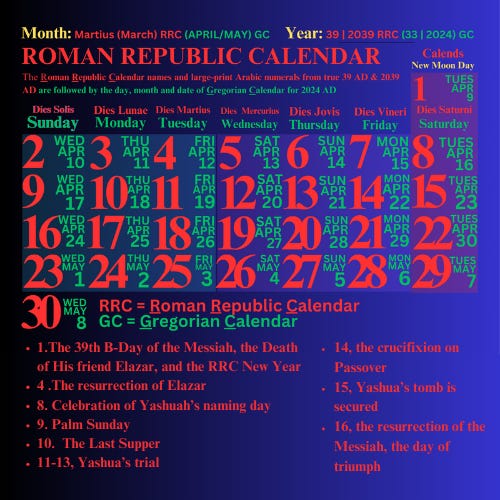
How to Use the Roman Republic in Gregorian Conversin Calendar
The dates of the Roman calendar are in red, and the corresponding Gregorian dates are in green. Day 1 is Calends, which is Roman New Moon Day. It has no corresponding New Moon Day at the beginning of the month. As you can see, Calends, Martius 1 falls on April 9th. Roman Martius, like Jewish Nisan, usually falls from the middle of Gregorian March to the middle of Gregorian April and may occur from the middle of April to the middle of May. This disparity between the Roman Republic or Jewish calendar and the Gregorian calendar is caused by the fact that the RRC and JC are lunar/solar calendars, whereas the Gregorian calendar is solar only. That’s why there is no Calends Day in the Gregorian calendar, as it is the first day of the month as fixed by the New Moon.
Day 4: The Resurrection of Yashua’s Friend Elazar
The fourth gospel account, written by the one I prefer to call Yahuhhanan, his true Hebrew name, as opposed to its English translation “John” or Spanish "Juan," chapter 11, covers what is very likely the first four days of the first month, including Calends, Sunday, Monday, and Tuesday. When Yashua got word of Elazar’s death on Calends, he stayed in Beyth-Anyah for another 2 days (Sunday and Monday), leaving Beyth-Anyah on Tuesday to go about 20 miles to Beyth-Hiniy, the village where Elazar was buried. Using the English equivalents of the Roman Days helps to get a sense of the time frame. Most English translations do not differentiate the names of the 2 villages, calling them the two "Bethanies.”
Day 8: The Banquet in Yashua’s Honor
Yahuhhanan 12 tells us that what Vine’s Expository Dictionary tells us was actually not a mere supper but rather an elaborate banquet in His honor. The fact that there is a tradition that Jewish birthdays are celebrated on the 8th day from their birthdays makes it plausible to infer that this is such an occasion, reinforcing Martius/Nisan 1 as the birth of Yashua. The way we know this is the 8th day of the month is from the beginning of chapter 12, where it says there was a banquet in Yashua’s honor 6 days before Passover. Since Passover is on the 14th, 6 days before Passover would be the 8th. Please check my math. Math is not my strong suit, but I don’t think this one is exactly rocket science. 14 minus 6 = 8, in my understanding.
Day 9: Palm Sunday, Martius 9 RRC
After the narrative of the party where Miriyam anointed Yashua with very expensive perfume, which the Messiah referred to a preparation for His death, in Yahuhhanan 12:12, we see the next day, that is, the day after the 8th, which of course is the 9th. Many scholars try to get away with saying that Palm Sunday was on the 10th. The last I heard, 8 + 1 = 9, not 10. So why do the synoptic gospels speak of the Triumphal Entry as being the day before Yashua’s cursing of the fig tree, and Yahuhhanan has a similar narrative after that day? I differentiate between the Synoptic account and the Yahuhhanine account by calling the first the Triumphal Entry and the second as Palm Sunday. Both days, Yashua entered Yerushalayim on a donkey. On the day of the cursing of the fig tree, there is no mention of a donkey. There is a Levite law that a donkey may not carry a burden on the Sabbath. Those who had seen Yashua raise Elazar from the dead no doubt made up the crowd of those saying Hosanna (Heb., Hoshiyanah). The cursing of the fig tree begins the Sabbath. On Roman Saturday, the Messiah walked into Yerushalayiym and did not ride a donkey because it was a Sabbath. He spent the whole day in the temple and went to Elazar’s house that evening for the banquet in the Messiah’s honor.
Day 10: The Last Supper/Passover Rehearsal
The Synoptics speak of Passover as being 2 days after the night that Miriyam would anoint Yashua with the very expensive perfume. Yahuhhanan refers to the same event as being 6 days before Passover. In Ancient Judaism, the 10th day of the month of Nisan was a day for a Passover rehearsal. That day was specifically spoken of in Shemowth (Exodus) chapter 12 as a day to select the Passover Lamb and capture it, as Yashua would be arrested. It was to be examined for the next 3 days and 3 nights to make sure it was without blemishes. I would infer that the Synoptic Passover was actually this Passover Rehearsal. Jews at that time would have known that by the context. Outsiders would be clueless, making it seem to be a point of contradiction between the Synoptic Gospels and the Gospel of John. There is a telling thing called “Shabbat HaGadol,” which Rabbis say occurred rarely on the 10th day, beginning the year of the Exodus, and not every year. Now they have it on the Saturday before Passover. I say that is telling because it appears that changing the 10th day, which is always Monday in the Roman Republic calendar, would be the second day of the week in the Hebrew calendar. It sounds like a cover-up to me.
It was still the night of the 10th when Yashua was arrested and taken to the High Priest to be examined. There were two High Priests (Heb. Coheniym Gadol) in Judaea in those days. Anyah was a Jewish Cohen Gadol. His son-in-law
Days 11-13: Three Days and Three Nights
Most scholars assume that the sign of the prophet Yonah is about the death burial and resurrection, but please consider this. When Yonah was 3 days and 3 nights in the belly of the great fish, he was being examined to see whether he would obey the Almighty Creator. Then he went to Ninevah to preach repentance. The Passover lamb was to be examined for 3 days and 3 nights to make sure it was without any blemishes. Yashua had a-3 day trial, and spent 3 days and 3 nights in David’s Palace, the heart of the earth, the center of Roman and Jewish power. Then, when He died, He went to preach to the souls in prison, having taken captivity captive. I could be wrong, but I don’t think so.
Day 11: The Messiah Examined by Herod
At 8 am on Tuesday, Martius 11, 39 AD RRC, the 2nd rooster trumpet sounded to open David’s Palace, which was being used for courtrooms above and prisons in the dungeons below. I say “rooster-trumpet sounded” because the Greek term Elektora is translated from the term Gallotrina, which literally means “the rooster crows” but was used for the sounding of the kind of trumpet used to signal each hour of the sun dial. Luke tells us that Herod & Pilate became friends that day. That would have needed to happen after the court day was over. Perhaps Herod and his wife had dinner with Pilate and Pilate’s wife, during which they discussed the case of Yashua. Herod had found no fault in Yashua and sent him back to Pilate’s dungeon.
Day 12: The Messiah Examined by Pilate
The morning of Wednesday, Martius 12, Pilate’s wife sent him a note while he was hearing Yashua’s case, telling him not to have anything to do with the blood of this innocent man. Pilate and Herod must have discussed Yashua’s case in front of their wives. She knew that Herod had found Yashua innocent, and no doubt she didn’t want Pilate to rock the boat with Herod now that they were friends.
Day 13: The Messiah Sentenced to Death by Pilate
At noon on Thursday, Martius 13, Pilate sentenced Yashua to death at a place called Gabbatha, meaning “the pavement.” Those who say that the trial and execution of the Messiah were on the same day have a problem, because by noon on execution day, He had been on the cross for 3 hours by that time.
Day 14: The Messiah Executed
At 9 am on Good Friday, Yashua was crucified at Golgotha, meaning “Skull Hill” or Calvary, borrowed from Latin. Gordon’s Calvary looks very much like a human skull.
(2) The Modern Jewish Calendar
The Modern Jewish Calendar originated with Hillel II, a Jewish associate of Constantine the Great, the Emperor of Rome, in the 4th century AD. Many say that Constantine changed the calendar. I would suggest, rather, that he had banned the use of the Roman Republic calendar. If Constantine had changed the calendar, I’m sure he would have taken credit or changed the name of one of the months, as Julius and Augustus did. No, by eliminating the Roman Republic calendar and promoting the Julian calendar, Constantine put the Jews in a real bind. When he allowed Hillel II to determine the yearly devotional appointments of the Jews by the moon cycles, but made them observe the Sabbaths on Saturdays, we can see how the Jewish calendar departed from a lunar Sabbath. The Roman Republic calendar had a lunar Saturday that was in synch with the lunar Sabbath. I believe this was how the Passover rehearsal was changed to Shabbat HaGadol. It really looks like a cover up to keep people from practicing a lunar Sabbath.
(3) The True New Year
In the Gemara, the most recent part of the Talmud, in Rosh HaShannah Tractate 10, we find a pair of Rabbis debating the spring vs. autumn creation of the universe. Rabbi Yashua was arguing for the spring creation in Genesis as being the first month, Nisan. Rabbi Elazar was giving the opinion, which seems to be the mainstream of Judaism, of the Autumn Creation in the month of Tishrei. Within that tractate, it is admitted that Nisan 1 is the only New Year supported by Scripture. There were four other “New Years Days” in Judaism. However, the other three would seem to be traditions by which the Pharsiys annulled the Scripture.
Conclusion: The Roman Republic Calendar Offers a Plausible Solution
We all know that a Saturday could never fall on a Sunday, even on the Gregorian calendar. In the same way, the Roman Republic Calendar would never have a Saturday fall on a calendar. I believe that before Constantine put a ban on the use of the Roman Republic calendar, the Hebrew calendar worked the same way. A Shabbath would never fall on Calends. Therefore, both the Hebrew Sabbath and the Roman Republic calendars were on the 8th, 15th, 22nd, and 29th of each month. The Roman Republic Calendar could help us see how Palm Sunday, the ninth of the month, would have always been a week before Easter Sunday, the 16th of the month, and how Good Friday could always be on Friday, the 14th. It also helps us to see how to relate to Yashua’s 39th birthday as being on Nisan 1/Martius 1 New Year’s Day. Don’t take my word for it. Please, I invite you to do your own research.